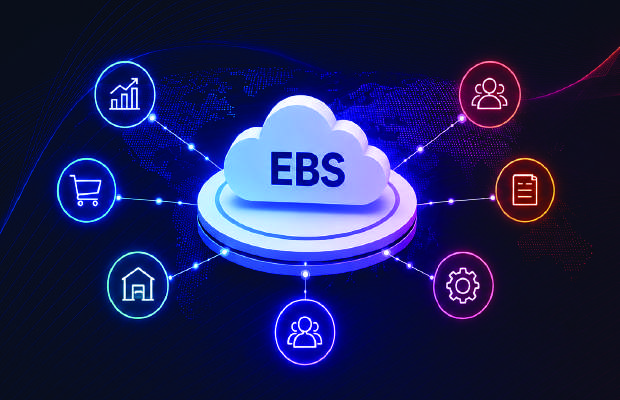

Most Oracle EBS Customers Don’t Need a New ERP System — They Need More from the One They Already Have

Most Oracle EBS Customers Don’t Need a New ERP System — They Need More from the One They Already Have
Picture of Winfo
Winfo

Oracle EBS Team

Oracle E-Business Suite has sat at the centre of enterprise operations for decades. It runs finance, procurement, supply chain, projects, HR, and asset management for organisations where downtime, instability, or operational disruption simply is not an option.

Yet despite how deeply embedded EBS remains, many organisations are still approaching it with the mindset of a platform that has peaked.

That perception no longer reflects reality.

Oracle continues to invest heavily in EBS — with long-term support, continuous feature releases, AI-driven capabilities, UX improvements, and expanding integration options across cloud and hybrid environments. At the same time, organisations are under growing pressure to reduce manual effort, improve operational visibility, strengthen controls, and modernise without introducing unnecessary risk.
Those two realities are converging in an interesting way.
Across customer conversations, the same pattern keeps emerging: organisations are often sitting on capabilities they already own but have never fully adopted.
The challenge is no longer whether EBS can evolve. The challenge is how organisations introduce change confidently enough to take advantage of what already exists within their estate.

The EBS Conversation Has Changed

For a long time, EBS discussions were centred around support timelines and platform stability.
Today, the conversation looks very different. Organisations are asking:
  • How do we reduce operational effort?
  • How do we improve visibility across the business?
  • How do we modernise without disrupting critical processes?
  • How do we adopt new capabilities safely in complex environments?

Enhancement

Description

AI-Powered Natural Language Querying

Ask questions of your data in plain language

Enterprise Command Centres (ECC)

Real-time operational dashboards and visibility

Redwood UX Improvements

Modern, intuitive user experience

Expanded Integration (OCI, APIs, APEX)

Seamless cloud and hybrid connectivity

Continuous Feature & Security Updates

Ongoing innovation across the suite

What is striking is how much of this capability already exists inside current customer environments. In many cases, organisations are still relying on manual workarounds while licensed functionality sits unused.
"EBS is not standing still — it's evolving continuously. The opportunity for customers is to unlock innovations they already own."
Terry Walton
Solution Engineering - EBS EMEA, Oracle
For many organisations, the goal is not replacement. It is reinvigoration.

Why Modernisation Efforts So Often Stall

Most organisations are not avoiding change because they do not see the value in it. They avoid change because of uncertainty.
EBS environments are heavily interconnected. A change in procurement can affect finance. A workflow adjustment can impact approvals, reporting, downstream integrations, or operational controls somewhere else in the business.
This creates a familiar — and costly — cycle:
Upgrades get postponed
    ↓
Enhancements are deprioritised
    ↓
Manual processes remain in place
    ↓
Technical debt increases
    ↓
Teams become even more cautious about future change
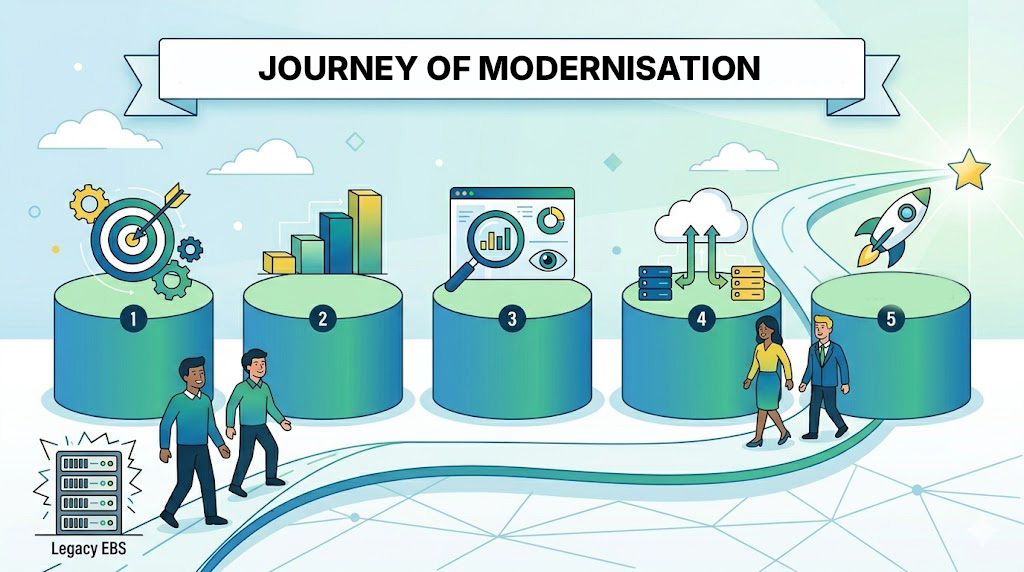
Over time, organisations end up preserving stability at the expense of progress.
The biggest blocker is often not the upgrade itself — it is the operational burden surrounding validation: manual regression testing, fragmented sign-off processes, limited visibility into downstream impact, and long validation cycles.
"I strongly believe that - Change isn't usually the problem — uncertainty around the impact of change is the real problem."
Dinesh Kanuga
VP – Business Solutions, Western Europe, Winfo Solutions
The result ? Organisations move slower than they need to, despite knowing there is clear value on the other side of change.

The Organisations Moving Forward Are Taking a Different Approach

The most successful EBS programmes are rarely trying to transform everything at once. Instead, they take a phased and controlled approach to modernisation:
  • Prioritising high-impact operational areas first
  • Introducing capabilities incrementally
  • Improving visibility before scaling change
  • Extending EBS selectively with cloud services where it adds value
  • Focusing on business outcomes rather than upgrade milestones
This shift changes how modernisation is experienced internally. Instead of a large-scale transformation that feels disruptive from day one, change becomes manageable, measurable, and easier for the business to absorb. And also aligns with how Oracle continues to evolve EBS itself — through continuous innovation rather than forced replacement cycles. 
The organisations seeing the most success aren’t those making the biggest changes fastest. The ones building confidence steadily over time are the real gainers.

Confidence Comes from Visibility

One of the clearest themes across customer discussions: organisations move faster when they can clearly see the impact of change before it reaches the business.
In practice, many teams still rely heavily on manual validation processes that are difficult to scale and even harder to repeat consistently. The more effective approach is to validate business operations end-to-end:

Validation Question

Purpose

Can Procure-to-Pay still run successfully?

Core process integrity

Are approvals and controls behaving correctly?

Governance assurance

Have downstream integrations been validated?

System-wide confidence

Can business teams clearly see what has been tested and signed off?

Transparency & trust

    This shifts the conversation from:

❌ “Did IT complete testing?”

                 to:

✅ “Can the business continue operating confidently after change?”

WinfoTest is designed to work directly within the Oracle EBS environment — allowing organisations to manage validation, testing, and business process assurance without stepping outside the platform. That tighter integration simplifies testing activity while giving both IT and business teams greater visibility into change readiness.
Automated regression testing helps organisations move from assumption-based change to evidence-based validation — giving teams greater visibility, repeatability, and confidence across upgrades and ongoing enhancements.
Once confidence improves, innovation adoption usually accelerates with it.

Unlocking More Value from Existing EBS Estates

Once organisations become comfortable introducing change, the conversation naturally moves beyond risk reduction and towards opportunity. Across EBS environments, organisations are increasingly exploring:
  • Enterprise Command Centres for operational visibility
  • AI-driven querying and reporting
  • Redwood UX improvements
  • Supplier and asset management enhancements
  • Hybrid cloud extensions
  • Automation opportunities across finance and procurement

Without confidence, organisations delay progress. With confidence, modernisation becomes significantly more practical.

Many of these capabilities are already available within existing estates today. The challenge is rarely access to technology — it is creating the operational confidence to use it properly.

Start with Understanding the Environment You Already Have

Before making decisions around upgrades, innovation, or broader transformation initiatives, organisations first need a clear understanding of their current environment:

Assessment Area

What It Reveals

Current versions & support position

Where you stand today

Existing customisations & integrations

Complexity and dependencies

Areas of underutilisation

Untapped capabilities you already own

Operational dependencies

Risk and impact mapping

Upgrade pathways

Practical routes forward

Risk & validation considerations

What needs to be tested and secured

Without that visibility, modernisation decisions are often driven by assumption rather than evidence.
A structured EBS assessment helps create a clearer starting point — and in many cases, organisations discover they are far closer to modernisation, than they initially assumed.
 

Rethinking What EBS Modernisation Actually Means

For many organisations, modernisation has become associated with replacement programmes, disruption, and large-scale transformation. But that is not always the reality.
Increasingly, the organisations getting the most value from EBS are not replacing stable environments unnecessarily. They are improving them steadily:
  • Reducing manual effort
  • Improving operational visibility
  • Validating change more effectively
  • Adopting innovation incrementally
  • Modernising with far greater control
EBS is still evolving. The question is whether organisations feel confident enough to evolve with it.

Watch the full on-demand webinar to hear Oracle and Winfo discuss:

  • How the EBS landscape is evolving
  • What organisations across EMEA are prioritising
  • Why upgrades and innovation often stall
  • Practical approaches to phased modernisation
  • How automated validation helps reduce operational risk
What do you think?
Leave a Reply

Your email address will not be published. Required fields are marked *

From our blog

Articles & insights

Agentic Cloud Operations: What AI Agents Should and Shouldn’t Do. Learn where autonomous agents add value, where human oversight is essential, and how to govern
Oracle Fusion AP automation uses AI agents to streamline invoice processing, improve cash visibility, strengthen controls, and reduce AP costs.
Modernize compensation planning with Oracle Workforce Compensation to improve budget control, governance, visibility, approvals, and fair rewards.