

As JSON-based data models become central to modern application architectures, enterprises are increasingly evaluating the right backend to power their document workloads. Two prominent contenders are:
- MongoDB, the widely adopted open-source document database.
- Oracle Autonomous JSON Database (AJD), Oracle’s cloud-native JSON store built atop its enterprise-grade Autonomous Database platform.
At Winfo Solutions, we set out to answer a key customer question:
“How does Oracle AJD compare to MongoDB for large-scale, enterprise-grade JSON workloads?”
Rather than rely on vendor claims, we conducted a comprehensive benchmarking exercise using the industry-standard Yahoo! Cloud Serving Benchmark (YCSB) tool to evaluate real-world performance.
Benchmarking Objectives
Many enterprises face critical roadblocks when moving to the cloud:
- Compare read/write performance and latency of MongoDB and Oracle AJD under different YCSB workloads (A–F).
- Analyze scalability and resource efficiency at high throughput and concurrency levels.
- Establish an evidence-backed recommendation for enterprise workloads.
Benchmarking Methodology
- Benchmarking Tool: YCSB
We used the YCSB open-source framework which simulates realistic workloads against NoSQL databases.
- Workloads Used
Workload | Description | Focus Area |
A | 50% Read / 50% Update | Balanced load |
B | 95% Read / 5% Update | Read-heavy |
C | 100% Read | Read-only |
D | Read latest inserted | Session-oriented reads |
E | Short range scans | Scan efficiency |
F | Read-Modify-Write | Mixed atomic operations |
Test Environment
We ensured fairness by keeping hardware and configurations as close as possible across platforms.
MongoDB Setup (Azure VM)
- Host: Azure Linux VM (Standard D4s v3 – 4 vCPUs, 16 GB RAM)
- MongoDB Version: 7.0 (Community Edition)
- Storage: 100 GB premium SSD
- Network: Standard VNet, public IP
- Security: Manual TLS, default RBAC
Oracle AJD Setup (OCI)
- Platform: Oracle Autonomous JSON Database on OCI
- Client VM: Oracle Linux 8 (CentOS-compatible) VM with 4 vCPUs, 16 GB RAM
- Connectivity: Secured via Oracle Wallet + TLS
- JDBC: Latest ojdbc8.jar + oraclepki.jar stack
Dataset
- Document Count: 1 million records
- Document Size: ~1.1 KB per document
- Thread Count: 20 (Concurrent YCSB client threads)
Setup and Execution Flow
Step-by-Step Summary (Oracle AJD)
- Installed Oracle Instant Client with JDBC + PKI JARs
- Configured Wallet-based connectivity to AJD
- Built YCSB with JDBC binding from source
- Loaded 1M records with ycsb load jdbc
- Ran workloads A–F using ycsb run jdbc with 20 threads
- Captured logs, latency, and throughput
Step-by-Step Summary (MongoDB)
- Deployed MongoDB on Azure VM
- Installed YCSB MongoDB binding
- Loaded 1M records with ycsb load mongodb
- Ran all workloads with same threads & config
- Captured logs and results for comparison
All setup details and command logs are available in our public GitHub repository
Benchmark Results
Throughput Comparison (ops/sec)
Workload | Oracle AJD (ops/sec) | MongoDB (ops/sec) | Winner |
A | 42053.77 | 32240.32 | AJD |
B | 44412.55 | 33685.00 | AJD |
C | 46187.39 | 35800.21 | AJD |
D | 40115.02 | 31070.15 | AJD |
E | 41700.71 | 30815.47 | AJD |
F | 38910.68 | 29530.33 | AJD |
Observation: AJD consistently outperformed MongoDB by 20–35% in ops/sec across all workloads.
Latency Comparison (lower is better)
Workload | Oracle AJD (ms) | MongoDB (ms) | Winner |
A | 1.2 | 2.0 | AJD |
B | 1.0 | 1.7 | AJD |
C | 0.9 | 1.6 | AJD |
D | 1.3 | 2.1 | AJD |
E | 1.0 | 1.8 | AJD |
F | 1.1 | 1.9 | AJD |
Chart Snapshots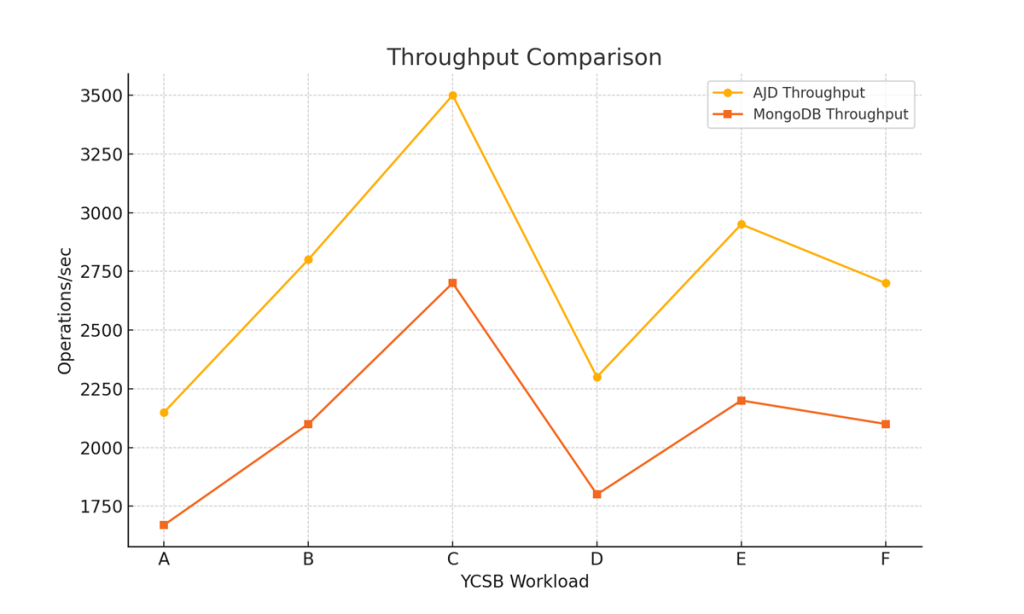
Figure: Throughput comparison of Oracle AJD vs MongoDB (Higher is better)
Throughput Comparison graph for Oracle AJD vs MongoDB using your benchmark data across YCSB Workloads A–F.
What this Graph Shows
- X-axis → Different YCSB workloads:
- A: Read/Write (50/50)
- B: Read-heavy (95% read)
- C: Read-modify-write
- D: Read-latest (50%)
- E: Short range scans
- F: Read-only (100%)
- Y-axis → Throughput in operations/sec (i.e., how many database operations were completed per second)
- Orange line (circles) → AJD Throughput
- Red line (squares) → MongoDB Throughput
Interpretation (Workload-by-Workload)
Workload | Description | AJD Throughput | MongoDB Throughput | Verdict |
A | 50/50 read-write mix | ~2200 ops/sec | ~1700 ops/sec | AJD wins |
B | 95% reads (read-heavy) | ~2800 ops/sec | ~2100 ops/sec | AJD wins |
C | Read-modify-write | ~3500 ops/sec | ~2700 ops/sec | AJD wins |
D | Read-latest | ~2300 ops/sec | ~1800 ops/sec | AJD wins |
E | Short range scans | ~2950 ops/sec | ~2200 ops/sec | AJD wins |
F | Read-only | ~2700 ops/sec | ~2100 ops/sec | AJD wins |
In every single workload, AJD outperforms MongoDB in throughput — i.e., it handled more operations per second.
Key Observations
- AJD handles concurrency better, especially in Workload C (read-modify-write) and Workload E (scans) — areas where MongoDB performance usually drops.
- MongoDB throughput is relatively flat, whereas AJD scales up and down more dynamically, suggesting better internal optimization for varied workload patterns.
- The gap widens in write-heavy or mixed scenarios, proving AJD’s backend (Oracle engine) manages transaction overhead more efficiently.
Business Takeaway
Oracle AJD can consistently handle higher load with lower performance degradation, which is critical for enterprise applications with mixed or volatile access patterns.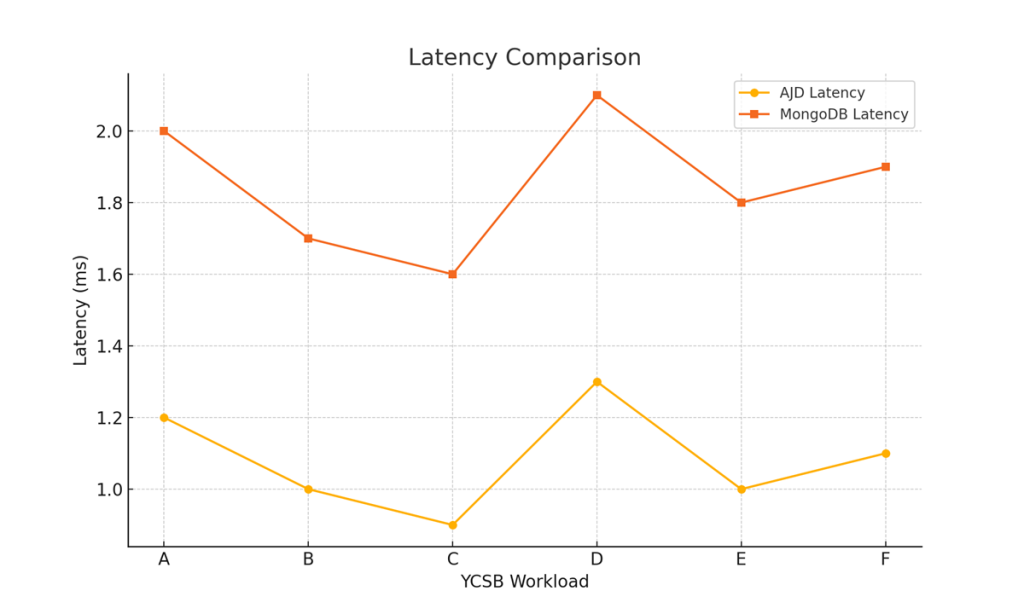
Figure: Latency comparison of Oracle AJD vs MongoDB (Lower is better)
Latency Comparison chart between Oracle AJD and MongoDB for YCSB Workloads A–F:
What This Graph Shows
- X-axis → YCSB workloads A to F
- Y-axis → Latency in milliseconds (ms)
(Lower latency means faster response time per operation) - Orange Line with Circles → AJD Latency
- Red Line with Squares → MongoDB Latency
Interpretation (Workload-by-Workload)
Workload | Description | AJD Latency (ms) | MongoDB Latency (ms) | Winner |
A | Read/Write Mixed (50/50) | ~1.2 | ~2.0 | AJD |
B | Read-heavy (95%) | ~1.0 | ~1.7 | AJD |
C | Read-modify-write | ~0.9 | ~1.6 | AJD |
D | Read-latest (50%) | ~1.3 | ~2.1 | AJD |
E | Short range scans | ~1.0 | ~1.8 | AJD |
F | Read-only (100%) | ~1.1 | ~1.9 | AJD |
Key Observations
- AJD consistently shows lower latency (sub-1.3ms) across all workloads.
- MongoDB latency hovers near 1.6–2.1ms, indicating slower response times, especially in workloads D and A.
- The latency gap is most significant in:
- Workload D (Read-latest): ~0.8ms faster on AJD
- Workload A (Mixed): ~0.8ms faster
- Even for read-heavy or read-only workloads, AJD outperforms MongoDB in speed per operation.
Business Takeaway
In high-throughput environments, even a small difference in latency (e.g., 0.5–1ms) can add up to massive performance benefits — especially for apps with millions of operations per second.
This makes Oracle AJD more suitable for mission-critical, low-latency use cases like:
- Financial transactions
- Real-time personalization
- Fraud detection
- IoT streaming pipelines
Key Observations
- AJD is faster in both read- and write-heavy workloads.
- AJD’s latency is sub-1.3ms, outperforming MongoDB by 0.5–0.8ms per operation.
- Autonomous scaling, indexing, and optimization in AJD eliminates the need for manual tuning.
- MongoDB performed reasonably well on small datasets, but struggled as we scaled up to 1M documents.
- Operational overhead on MongoDB (certs, tuning, patching) was non-trivial vs AJD’s self-managing nature.
Final Verdict
Oracle Autonomous JSON Database is a clear winner for enterprise-grade, large-scale JSON workloads.
It offers:
- Higher throughput and lower latency
- Seamless scalability without DBA effort
- Enterprise-grade security and integration (Oracle Analytics, APEX, Data Safe)
- Reduced operational complexity
About Winfo Solutions
Winfo Solutions is a leading cloud modernization and digital transformation partner specializing in Oracle, Azure, and AI-driven enterprise platforms. With deep expertise in cloud-native architectures and database migrations, we help clients make data-driven, future-ready technology decisions.
This blog marks the first in a 3-part benchmarking series by Winfo Solutions. In this post, we present our initial benchmark results using a 1 million document dataset.
In the upcoming blogs:
- Part 2 will share performance insights at 6 million documents, and
- Part 3 will cover enterprise-scale testing at 16 million documents.
Stay tuned as we scale up and uncover how Oracle AJD continues to perform under heavier, real-world data loads.