

In today’s hybrid cloud world, enterprises demand flexibility, performance, and compliance — all without being locked into a single cloud provider. Enter Oracle Database@AWS — a revolutionary multicloud solution that combines the best of Oracle’s database infrastructure with the reach and elasticity of Amazon Web Services (AWS).
What is Oracle Database@AWS?
Oracle Database@AWS enables customers to run Oracle’s most powerful database offerings — like Exadata Database Service and Autonomous Database – Dedicated — natively inside AWS data centers, within their own AWS Virtual Private Cloud (VPC), but fully managed by Oracle via the OCI (Oracle Cloud Infrastructure) Console.
“It is not a “lift and shift.”
It’s a first-party managed service delivered by Oracle, designed for real enterprise workloads, with:
- No compromises on performance
- No data egress charges
- No complex refactoring of applications
Oracle Database@AWS: Seamless Integration and Unified Experience
Ref: Oracle and AWS webinars: Oracle and AWS Team Up – Oracle Database@AWS
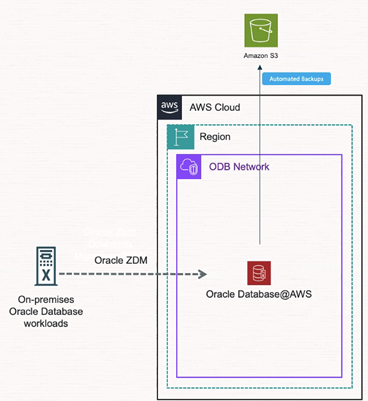
- ODB Network: Secure and Isolated Subnet — The ODB Network is a secure, dedicated subnet within your chosen AWS Region, isolated from your VPC to ensure compliance and protection of Oracle workloads. It connects seamlessly to Amazon S3 for automated backups and lifecycle management, and supports Zero Downtime Migration (ZDM) from on-premises environments. This architecture keeps databases secure while enabling tight integration with AWS-native services.
- Unified Management and Observability — Oracle Database@AWS delivers a unified multicloud experience by integrating support, purchasing, and operations. Enterprises can subscribe via AWS Marketplace or Oracle, monitor Exadata metrics natively in AWS CloudWatch using the AWS/ODB namespace, and track key usage insights like CPU utilization. This approach leverages existing Oracle and AWS skillsets, minimizes operational overhead, and qualifies for Oracle Support Rewards to lower license costs—empowering organizations to run Oracle workloads on AWS with familiar tools and streamlined operations.
- Unified Data with Zero-ETL — Oracle Database@AWS leverages its low-latency ODB Network to integrate seamlessly with AWS services, enabling Zero-ETL data flows into Amazon analytics platforms. This eliminates the need for traditional ETL pipelines, delivering faster insights, reduced complexity, and real-time access to Oracle data for analytics and AI workloads.
Oracle Database@AWS enables enterprises to power real-time analytics and modern applications by streaming data from Exadata and Autonomous Databases directly into AWS services like QuickSight, Athena, Redshift, and AI/ML stacks. Leveraging a secure, high-speed ODB Network, native CloudWatch monitoring, and Zero-ETL integration, it connects Oracle data seamlessly to AWS compute (EC2, EKS, ECS) for AI-driven microservices, vector search, and ERP extensions. This multicloud synergy unites Oracle and AWS capabilities while optimizing costs through Oracle Support Rewards and AWS consumption commitments.
Deploying Oracle Database@AWS: Architecture Patterns and Best Practices
- Single-AZ: Simple, low-latency start
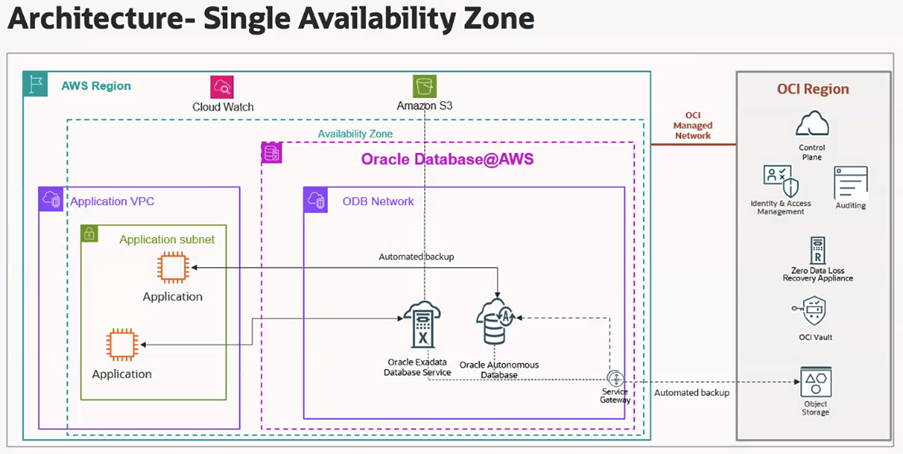
“Single AZ diagram”
Ref: Oracle and AWS webinars: Oracle and AWS Team Up – Oracle Database@AWS
Why this pattern — Keep app + database in the same AZ for the lowest latency and the fewest moving parts. Great for pilots, steady workloads, or when HA is already handled at the app layer.
How it’s laid out
- App VPC (same AZ): EC2/EKS/ECS in private subnets.
- ODB Network (Oracle-managed VPC enclave): Exadata DB Service and/or Autonomous DB running inside AWS.
- Private connectivity: VPC peering/PrivateLink between App VPC and ODB Network.
- Backups: Automated to Amazon S3 (and optionally to OCI Object Storage/ARS).
- Ops: Metrics in CloudWatch; lifecycle (provision, patch, scale) in OCI Console.
Traffic flow — App → Private VPC route → ODB Network endpoint → Exadata/Autonomous DB
Backups → S3; optional offsite copy → OCI
When to choose
- Single-AZ apps needing millisecond DB latency
- POCs/MVPs
- Teams wanting the fastest time-to-value
Gotchas
- AZ failure = app impact. If you need zone resilience, pick the hub-and-spoke design.
- Ensure NACL/SG rules are aligned on both sides before provisioning.
2) Hub-and-Spoke (Same Region) with Transit Gateway
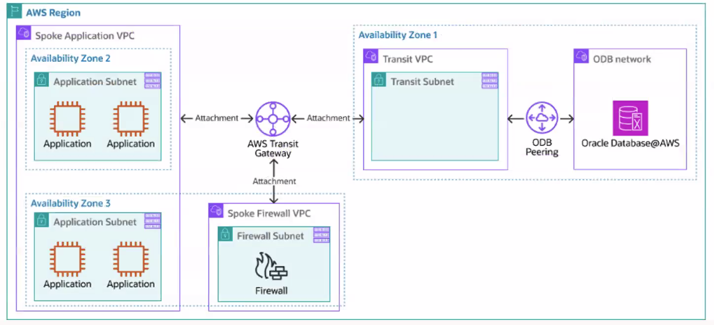
“Same region TGW + Firewall/Transit VPC + ODB Network”
Ref: Oracle and AWS webinars: Oracle and AWS Team Up – Oracle Database@AWS
Why this pattern — You’ve got multiple app VPCs (Sales, Marketing, BI, etc.) that must securely reach a shared Oracle DB. TGW gives centralized routing, scale, and segmentation.
How it’s laid out
- Spoke VPCs: Independent app VPCs (often across multiple AZs).
- (Optional) Firewall VPC: Central inspection (Palo Alto/Check Point) for egress control, DPI, logging.
- Transit Gateway (Hub): Attaches all spokes and the Transit VPC.
- Transit VPC: Holds TGW attachment + routing toward the ODB Network.
- ODB Network: Oracle-managed enclave hosting Exadata/Autonomous DB in the same AWS region.
- Monitoring & Ops: CloudWatch + OCI Console.
Traffic flow — Spoke App VPC → TGW → (Firewall VPC, if used) → Transit VPC → ODB peering → Exadata/AutonomousDB
Security notes
- Central guardrails in Firewall VPC
- Route tables per attachment = precise least-privilege
- Private only; no public IP exposure for DB
When to choose
- Many VPCs/teams, shared database backend
- Need network segmentation + centralized security
- Same-region HA across AZs on the app side
Gotchas
- Plan CIDR to avoid overlap (TGW won’t fix bad addressing).
- Keep TGW route tables tidy (one per environment often works best).
- Size firewall instances for throughput if you insert one.
3) Hub-and-Spoke (Cross-Region)
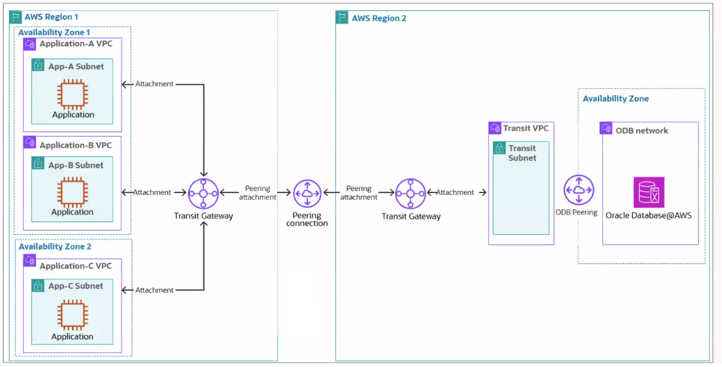
“Region-1 Apps → TGW Peering → Region-2 ODB Network” diagram.
Ref: Oracle and AWS webinars: Oracle and AWS Team Up – Oracle Database@AWS
Why this pattern — Run apps in Region-1 and centralize Oracle Database@AWS in Region-2 (or vice-versa). Useful for DR, data residency, or global SaaS designs.
How it’s laid out
- Region-1: Multiple App VPCs attach to TGW-1.
- Inter-region TGW peering: Private, encrypted backbone between TGW-1 ↔ TGW-2.
- Region-2: Transit VPC + ODB Network hosting Exadata/Autonomous DB.
- Backups: S3 in Region-2; optional cross-copy to OCI.
Traffic flow — App (Region-1) → TGW-1 → TGW Peering → TGW-2 → Transit VPC → ODB peering → DB (Region-2)
Latency & DR
- Expect tens of ms inter-region latency; size timeouts/pooling accordingly.
- Easy to add a standby ODB in another region for DR in future phases.
When to choose
- Centralized DB with geo-distributed apps
- Regulatory or sovereignty constraints
- Multi-region HA/DR strategy
Gotchas
- Watch data transfer costs over TGW peering for chatty OLTP.
- Ensure MTU and SG/NACL parity across regions.
- Align IAM and KMS/Vault policies across both sides.
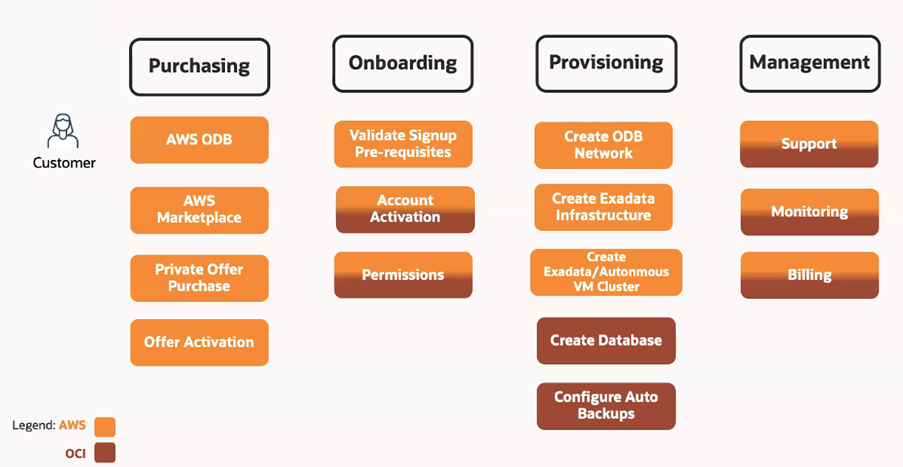
Oracle Database@AWS – Customer Onboarding Journey — To ensure a smooth and structured experience, Oracle has designed a 4-phase customer journey for deploying and managing Oracle Database@AWS. This process streamlines the steps from procurement to operational management, across both AWS and OCI platforms.
Ref: Oracle and AWS webinars: Oracle and AWS Team Up – Oracle Database@AWS
1: Purchasing Oracle Database@AWS — is fully managed through AWS, starting with selecting the service from supported offerings and subscribing via the AWS Marketplace. Enterprises can use the AWS Private Offer mechanism for negotiated pricing, then activate the offer to enable provisioning — all handled through AWS Marketplace and the AWS Billing Console.
2: Onboarding to Oracle Database@AWS — in a hybrid AWS + OCI setup involves jointly validating prerequisites — ensuring the customer has active OCI and AWS accounts with required configurations. Once ready, the OCI tenancy is activated and securely linked with AWS IAM credentials. Finally, IAM roles and policies are configured across both clouds to enable seamless cross-cloud orchestration, leveraging the OCI Console, AWS IAM, and Oracle Support
3: Provisioning for Oracle Database@AWS — managed by OCI, starts with creating the ODB Network — a secure, private OCI-managed network within AWS for Exadata or Autonomous Database. Next, the Exadata infrastructure is provisioned on bare-metal compute and storage, followed by launching VM clusters for either Autonomous or user-managed deployments. Databases are then created and configured, with automated backup policies enabled to store backups in Amazon S3 and/or OCI Object Storage, all orchestrated through the OCI Console.
4: Management of Oracle Database@AWS — is a joint responsibility between Oracle and AWS. Enterprises can access Oracle’s technical support for both database and infrastructure, monitor performance using OCI-native tools (Metrics, Alarms) alongside AWS CloudWatch integration, and handle billing via AWS while OCI meters the underlying usage. All ongoing operations are managed through the OCI Console, AWS Billing Console, and Oracle My Support, ensuring smooth multicloud visibility and control.
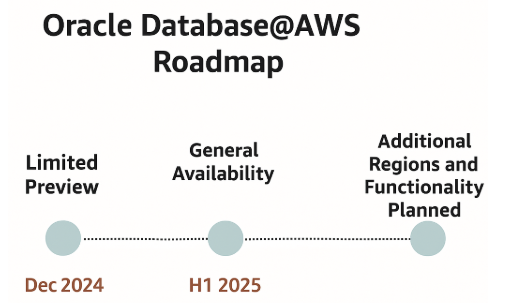
Oracle Database@AWS – Roadmap — Oracle’s vision for Oracle Database@AWS is rooted in a phased and regionally expanding rollout to ensure enterprise readiness, high availability, and scalable performance from Day 1.
Here is a snapshot of the current and upcoming milestones:
Phase | Timeline | Details |
Limited Preview | December 2024 | Available in Northern Virginia (us-east-1)Only Exadata Database ServiceWhite glove onboarding for early adopters |
General Availability (GA) | H1 2025 | Full Production readiness in two AWS RegionsSupport for both Exadata DB Service and Autonomous Database – Dedicated |
Future Expansion | Planned | More AWS regions and Availability ZonesAdditional features, automation, and tighter OCI-AWS integration |
Ref: Oracle and AWS webinars: Oracle and AWS Team Up – Oracle Database@AWS
Current Coverage: Two AWS Regions
Planned: Expansion to more regions with added capabilities — This roadmap indicates Oracle’s long-term commitment to deeply embedding its database expertise within the AWS ecosystem — offering multicloud without compromise.
Summary & Conclusion
Oracle Database@AWS represents a landmark evolution in multicloud architecture — fusing Oracle’s market-leading database technology with AWS’s infrastructure ubiquity.
Here’s what sets it apart:
Best of Both Worlds Run — Oracle’s most powerful database engines — Exadata and Autonomous — on AWS, with OCI managing the backend seamlessly.
Unified Control, Native Feel — Provision and manage everything via the OCI Console, but purchase, monitor billing, and host within your existing AWS VPC.
Enterprise-Grade Features — Enjoy the power of Exadata with advanced storage, automated backups, patching, HA/DR, and monitoring — now in AWS.
TCO Optimization — No need for data egress or custom apps migration. Keep workloads in AWS and still enjoy Oracle’s fully managed experience.
Security & Compliance — OCI manages everything from provisioning to patching, while AWS IAM and networking policies are fully respected.
Final Verdict
Oracle Database@AWS is not just a deployment option — it’s a cloud strategy.
It’s built for regulated industries, critical enterprise apps, and forward-thinking architects who want to break cloud silos without compromising performance, cost, or governance.
By bridging Oracle and AWS, this offering delivers true multicloud freedom, setting a new standard for what’s possible in hybrid cloud innovation.
How Winfo Can Help — Winfo Solutions brings deep expertise in Oracle and AWS integration, enabling enterprises to adopt Oracle Database@AWS with speed, precision, and minimal disruption. From architecture design and secure onboarding to provisioning, automation, and cost optimization, we ensure a smooth multicloud deployment aligned with your compliance and performance goals. Leveraging our proven methodologies and strong partnerships with both Oracle and AWS, we help you unlock the full potential of multicloud — accelerating time-to-value while reducing operational risk.
About Winfo
Winfo is a global IT solutions company. As a key Oracle partner we provide implementation and support services for Oracle Fusion and E-Business Suite customers. To address a gap in the market we have also developed a number of Accelerators to help clients automate business processes, streamline their testing of patches and updates and developed a data mining accelerator to help get the most out of their ERP data.
Don’t Miss an Update…
Get the latest Oracle updates and expert insights delivered straight to your inbox.
Don’t miss out on these Insights!
Here are some other articles you might be interested in